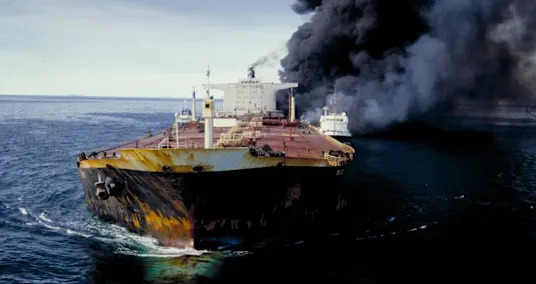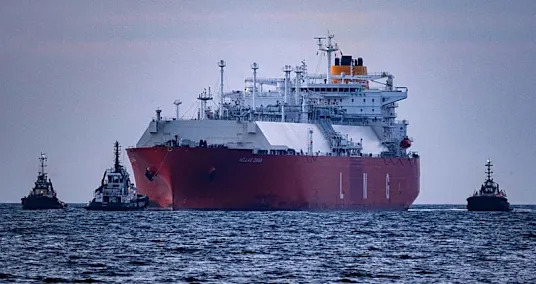
Germany has begun receiving its first-ever liquefied natural gas deliveries from Oman, even as war in the Middle East chokes global supply routes — but a deeper look at the country's gas supply chain suggests Berlin may be more exposed to the crisis than official figures let on.
The shipments, delivered under a four-year contract signed in 2023 between Oman's state LNG producer and German gas importer Securing Energy for Europe (SEFE), began as planned this month, a SEFE spokesperson told the German Capital magazine.
Oman sits on the far side of the Strait of Hormuz from Iran, and the company said deliveries are unaffected by the ongoing conflict.
The news offers a rare bright spot in an otherwise tightening energy picture.
Iran's blockade of the strait has halted all LNG exports from Qatar, the world's second-largest LNG exporter, while an Iranian strike on Qatar's Ras Laffan production facilities in mid-March knocked out 17% of the Gulf state's output capacity.
QatarEnergy chief executive Saad al-Kaabi said repairs will take three to five years.
The company has since invoked force majeure on several long-term contracts, with customers in China, South Korea, Italy, and Belgium among those affected.
Economics Minister Katherina Reiche has sought to play down the risks, saying Germany receives "no significant quantities" of LNG from the Gulf and that 90% of its gas arrives via pipeline from Norway, the Netherlands, and Belgium.
Germany more exposed than expected?
Those figures are technically accurate — but they obscure a more complex picture, according to Capital.
Only 10.3% of Germany's gas imports arrived via its own four LNG terminals last year, all of it almost entirely from the US.
However, the Netherlands and Belgium, which together supplied 45% of Germany's total gas imports in 2025, are themselves among the EU's largest LNG importers.
Rotterdam and Zeebrugge receive large volumes of liquefied gas by tanker, regasify it, and pipe it onward into Germany.
Belgium's Zeebrugge terminal handled a record 55.5 terawatt-hours of LNG in 2025, double its previous record.
The Netherlands sourced 45% of its total gas imports as LNG in 2024, with American cargoes accounting for 30% alone, Capital reports.
Because the origin of individual gas molecules moving through pipelines cannot be traced, the true scale of Germany's indirect LNG dependency — and its indirect exposure to US supply — is impossible to pin down precisely. But the direction of travel is clear.
Germany's storage levels add to the pressure. Reserves currently stand at around 22%, historically low for this point in the year, according to Capital.
LATEST POSTS
- 1
 My prescription costs what?! Pharmacists offer tips that could reduce your out-of-pocket drug costs
 - 2A quick recap of 'Stranger Things' Seasons 1-4, plus key episodes to rewatch before Volume 1 of the final season drops
- 3Two more UN peacekeepers killed in southern Lebanon: UNIFIL
- 4Under pressure at home, Belgium's leader treads a tight rope with EU partners over funds for Ukraine
- 5Financial plan Cordial Home Redesigns That Add Worth




- Inside the alleged Russian operation to trigger anti-government protests in Angola
- The Red Sea strategy: What does Israel stand to gain from recognizing Somaliland?
- OPEC’s No. 2 Producer Burns Its Own Gas—Then Buys Iran’s
- Find Serenity: 10 Stunning Setting up camp Areas
- Two Indonesian UN peacekeepers killed in explosion in Lebanon
- 2024's Hot Games: Must-Play Titles of the Year
- 'No middle ground' for tackling antisemitism after Bondi Beach mass shooting, deputy FM Haskel says
- Procter & Gamble changes Crest toothpaste packaging to address Texas AG fluoride concerns
- Manual for Purchasing a Modest Jeep Wrangler for Seniors