JUNO BEACH, Fla. (AP) — The veterinary staff at a Florida sea turtle hospital is getting help from space to monitor the animals they have rehabilitated. They're particularly interested in amputees.
Using satellite tracking devices in a collaboration between the Loggerhead Marinelife Center and the Smithsonian Conservation Biology Institute, scientists are learning how well sea turtles can survive in the wild after losing a limb.
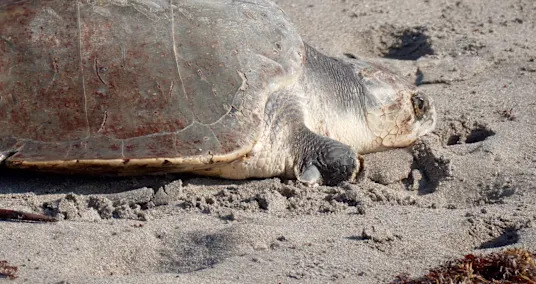
Amelie, a Kemp's ridley sea turtle who lost her right forelimb to a predator — most likely a shark, the center said — was taken to the beach on Wednesday for her highly anticipated release. The turtle paused for about 30 seconds, then slowly made her way into the Atlantic Ocean as onlookers cheered.
Amelie had been rescued and brought to the center by the Inwater Research Group in Port St. Lucie, Florida, seven weeks earlier after a traumatic amputation. She underwent surgery to clean and close the wound, and was treated for pneumonia while in a tank at the center. When veterinarians deemed her healthy enough to return to the sea, they glued a tracking device to her shell.
An ultrasound confirmed that Amelie is developing eggs, giving researchers another reason to track her movements.
Kemp's ridley turtles, the rarest of sea turtle species, are more typically found on Florida's Gulf Coast, so treating Amelie was especially significant, said Andy Dehart, the center's president and CEO.
Amelie is actually the fourth amputee sea turtle being tracked by the enter, Loggerhead research director Sarah Hirsch said. They include a three-limbed turtle named Pyari who has traveled nearly 700 miles since her release in January, her tracker shows.
“We do know that they can be successful in the wild because we have seen them on our nesting beaches, but we really want to understand their dive behaviors, how they’re migrating once they’re back in the wild," Hirsch said.
The satellite tags have a saltwater switch that detects when the turtle comes up to the surface to breathe, triggering the transmission of data to the satellites. Their location appears online after a 24-hour delay. To view Amelie and other turtles tracked for various research projects, visit the Loggerhead website.
“They’ve been through a lot," Hirsch said. "They’ve gotten a lot of medical care here, and to see them be able to go back out and contribute to the population is really rewarding.”
To view Amelie and other turtles tracked for various research projects, visit the Loggerhead website.
—
Frisaro reported from Fort Lauderdale, Florida.
LATEST POSTS
- 1
 What causes RFK Jr.’s strained and shaky voice? A neurologist explains this little-known disorder
 - 2First part of major new German-Danish tunnel cleared for lowering
- 3New dietary guidelines recommend more dairy, meat and fats: What to know
- 4The most effective method to Pick the Ideal Lab Precious stone Wedding band
- 54 astronauts depart ISS, leaving behind just 3 crewmates to staff the orbiting lab





- Misinterpretations and Mistakes Portrayed by Hollywood in the General set of laws
- Dozens injured in Russia after train crashes, overturns
- 2024's Savvy Home Gadgets for an Associated Way of life
- Ethiopian earthquakes and volcanic eruptions: earth scientist explains the link
- Scientists dove hundreds of feet into the ocean and found creatures no human has ever seen. Our trash beat us there
- Artemis II updates: NASA's moon mission breaks Apollo record for farthest distance humans have traveled from Earth
- Mossad unveils network of Hamas terror infrastructure across Europe
- ACA subsidies latest: Making sense of what's happening with health care after Republicans revolt, forcing a vote on funding extension
- One dead, six wounded in various crime-related shootings in Israel over the weekend