By Joey Roulette
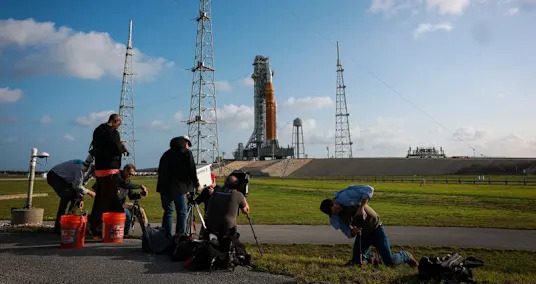
CAPE CANAVERAL, Florida, March 30 (Reuters) - NASA is preparing to launch the first crew of astronauts toward the moon in over 53 years with its second Artemis mission, a key test flight in humanity's broader lunar goals as the U.S. races to reassert leadership in space faced with growing competition from China.
Three U.S. and one Canadian astronaut are due for liftoff aboard NASA's Orion capsule and Space Launch System rocket on Wednesday for a 10-day test mission swinging around the moon and back, a winding journey taking them deeper into space than humans have ever gone before.
The mission is the first crewed test flight in NASA's Artemis program, the flagship U.S. effort to begin regular flights to the moon, at an estimated cost of at least $93 billion since 2012. Not since Apollo 17 in 1972 have humans touched down on the moon's surface, a tricky feat NASA aims to repeat in 2028 at the rugged lunar south pole.
The U.S. is the only country to have put humans on another celestial body with its six lunar landings of the Apollo program, driven by competition with the former Soviet Union.
China, a formidable technological rival to the U.S., has made steady progress in its own moon program in recent years, with a string of robotic lunar landings and a 2030 goal to put its own crew on the surface. U.S. officials have focused on beating China to the surface.
ANSWERING 'THE QUESTION OF OUR LIFETIME'
NASA astronaut Christina Koch, Artemis II mission specialist, on Sunday said the moon is a "witness plate" to the solar system's formation, and a stepping stone to Mars, "where we might have the most likelihood of finding evidence of past life."
"Many, many countries have recognized the value that there is in exploring further into the solar system, to the moon and on to Mars," she told reporters. "They recognize that not only can we gain all these extremely tangible benefits, but that we have the opportunity to answer the question that could be the question of our lifetime, which is, are we alone?"
"Answering that question starts at the moon," she said. "The question is not should we go, but should we lead, or should we follow?"
Through a series of increasingly advanced Artemis missions extending into the next decade, the U.S. aims to set precedent for how others will operate and coexist on the moon's surface, where someday countries and companies can exploit rocky lunar resources and practice for much more difficult missions to Mars.
COMMERCIAL LUNAR MARKET
NASA is relying on an array of companies in its moon program with the hope of stimulating a commercial lunar market in the future, the value of which is hard to estimate, analysts say.
A PricewaterhouseCoopers report from January estimates $127 billion in revenues by 2050 from lunar surface activities, with investments potentially reaching $72 billion to $88 billion through the same period.
But for now, and in the near future, governments will drive companies' lunar strategies and revenue. It will be a long time before commercial growth exists on the moon independently of government funding, said Akhil Rao, an economist at analysis firm Rational Futures who was a research economist at NASA.
"NASA did not see a short-run economic value that companies would be able to derive that would allow NASA to be hands-off," said Rao, who was among a team of economists and space policy staff laid off last year amid the Trump administration's sweeping federal workforce cuts.
The Artemis II mission will pose a greater test of NASA's Orion capsule and SLS, which conducted a similar mission without crew in 2022. The astronauts on board will test critical life-support systems, crew interfaces, navigation and communications before NASA proceeds with more complex missions in the following years.
Liftoff is scheduled for April 1, though it could happen any day after until April 6, depending on weather conditions in Florida and any last-minute snags with the rocket. Thereafter, another launch window, determined largely by the orbital mechanics between Earth and the moon, opens on April 30.
Artemis III, the next mission planned for 2027, will involve the Orion capsule docking in Earth's orbit with NASA's two lunar landers - the Blue Moon system from Jeff Bezos' Blue Origin and Starship from Elon Musk's SpaceX. The delicate tag-up will demonstrate how the landers will pick up astronauts before heading for the moon's surface.
That mission was added to the program in February by NASA's new administrator, Jared Isaacman, a billionaire private astronaut who has more broadly shaken up the program with new objectives. His decision pushed the program's first crewed lunar landing to Artemis IV.
The architecture is more complex than the Apollo missions, involving an array of companies funded by NASA with the hope of stimulating private competition and market activity around the moon. Boeing and Northrop Grumman lead SLS and Lockheed Martin builds Orion for NASA.
SpaceX and Blue Origin are developing their own landers with NASA funding but under different types of contracts that allow them to offer the spacecraft to other customers.
(Reporting by Joey Roulette at Cape Canaveral; Editing by Bill Berkrot)
LATEST POSTS
- 1
 Qantas and Virgin Australia Ban Power Bank Usage on Flights Following Safety Incidents
 - 2Newly identified species of Tanzanian tree toad leapfrog the tadpole stage and give birth to toadlets
- 3NASA's Perseverance Mars rover could break the record for miles driven on another planet
- 4Foreign journalist kidnapped in Iraq: Interior Ministry
- 5Zelensky confidant dismissed from further posts amid bribery scandal




- Fundamental Venture The board Apparatuses for Remote Groups
- Step by step instructions to Contrast Lab Precious stones and Normal Jewels
- Vote in favor of Your #1 4\u00d74 SUVs
- Manual for Purchasing a Modest Jeep Wrangler for Seniors
- Vote In favor of Your Favored Video Conferencing Administration
- 5 Arising Professions in Environmentally friendly power
- Two die and thousands homeless after flooding hits Russia's Dagestan
- Gulf countries continue to face Iran attacks as criticial energy infrastructure at risk
- Passenger Missing After Going Overboard Disney Cruise Ship