When you buy through links on our articles, Future and its syndication partners may earn a commission.

The seventh-ever mission of Japan's H3 rocket did not go according to plan.
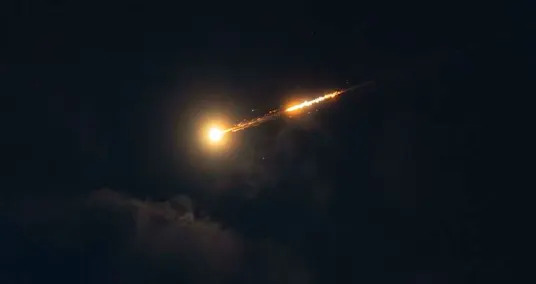
The H3 launched from Tanegashima Space Center on Sunday (Dec. 21) at 8:51 p.m. EST (0151 GMT and 10:51 a.m. local Japan time on Dec. 22), carrying a navigation satellite known as Michibiki 5, or QZS-5, aloft.
"However, the second stage engine’s second ignition failed to start normally and shut down prematurely," officials with the Japan Aerospace Exploration Agency (JAXA) said in a statement early Monay morning (Dec. 22). "As a result, QZS-5 could not be put into the planned orbit, and the launch failed."

The 10,580-pound (4,800 kilograms) Michibiki 5 was supposed to be part of Japan's homegrown Quasi-Zenith Satellite System (QZSS), a navigation network in geosynchronous orbit high above Earth.
"This system is compatible with GPS satellites and can be utilized with them in an integrated fashion," Japanese officials wrote in a description of the QZSS project.
"QZSW can be used even in the Asia-Oceania regions with longitudes close to Japan, so its usage will be expanded to other countries in these regions as well," they added.
The first QZSS satellite, a pathfinder, launched in September 2010. The system currently consists of four operational spacecraft, but Japan wants it to grow, as Sunday's unsuccessful launch shows. Indeed, the network will eventually consist of 11 spacecraft, if all goes according to plan.
The two-stage H3 rocket was developed by JAXA and Mitsubishi Heavy Industries. It's the successor to the H-2A, a workhorse launcher that retired in June after a quarter-century of orbital service.
The H3 failed during its debut launch in March 2023 but bounced back with five consecutive successes — until Sunday night. JAXA has set up a task force headed by agency chief Hiroshi Yamakawa to help get to the bottom of the Michibiki 5 launch anomaly.
"We would like to express our deepest apology to many people and entities, particularly those related to the QZS-5, local organizations and the public, who had high expectations for this project," JAXA officials wrote in Monday morning's update.
LATEST POSTS
- 1
 Women take pride in Holy Week roles after a Spanish Catholic brotherhood's procession excluded them
 - 2Saudi Arabia says it intercepted 7 missiles, debris falls near energy facilities
- 3To fix a patient's irregular heartbeat, doctors first tested its digital 'twin'
- 4They died 'doing what they loved': The stories of workers in their 80s who died on the job
- 5UK forecast to face weaker growth and higher inflation from Iran war



- The Best Games On the planet
- Where You Could Sleep With Snorlax in Japan, From MIMARU’s Pokémon Rooms to Grand Hyatt Tokyo’s Limited Pokémon Suite
- German petrol stations hike prices as once-a-day rule takes effect
- Israel says soldiers wounded in Gaza fighting amid fragile truce
- Presenting Nintendo's New Pastel Satisfaction Con Tones for Switch Gamers: 3 Upscale Choices
- Meet the Artemis crew in NASA's first astronaut mission to the moon in more than a half-century
- Hundreds of kilos of protected plant seized by Israel Nature and Parks Authority in Golan
- Discovery of massive spider's web in Greece reveals unexpected behavior
- Why boosting production of Venezuela's 'very dense, very sloppy' oil could harm the environment